Drone metal takes the most physical element of heavy music, the sound of a distorted guitar through a loud amplifier, and removes almost everything else. Tempo slows until rhythm becomes geological. Riffs stretch until they become single chords held for minutes. What remains is sustained mass: a wall of low frequencies that audiences feel in the chest as much as hear. The genre sits at an unusual crossroads, drawing equally on doom metal and on the minimalism of La Monte Young and Tony Conrad.
What drone metal is
The defining features of drone metal are easy to list and surprisingly hard to imitate:
- Extreme duration. Tracks of 15, 20 or 30 minutes are normal.
- Minimal harmonic movement. Pieces often rest on one chord or a slow alternation of two.
- Saturated, sustained guitar tone. Distortion and feedback turn each note into a dense field of overtones.
- Little or no drumming. When percussion appears, it is sparse and very slow.
- Volume as a structural element. Live, the physical pressure of the sound is part of the composition.
The genre is related to doom metal, which shares the slowness and the downtuned weight, but doom keeps the song: verses, riffs, vocals and a recognisable rock structure. Drone metal abandons the song in favour of the sound itself.
The origins: Earth 2 (1993)
Most histories of the genre begin with one record. Earth, the Seattle-area group led by guitarist Dylan Carlson, released Earth 2: Special Low Frequency Version on Sub Pop in February 1993. It consists of three tracks running to about 73 minutes, recorded in August 1992 and produced by the band with Stuart Hallerman.
The timing was strange. Sub Pop was then the most visible label of the grunge boom, and Earth 2 was released into the same market as Nirvana and Soundgarden. What listeners found instead was a slow, almost motionless mass of guitar and bass. The record was commercially marginal, yet within a few years it had become a reference point. Distorted Sound Magazine describes it as a seminal work, and Sub Pop marked its 30th anniversary in 2023 with a repress and a companion remix album.
Earth’s lineage is itself instructive. The subtitle Special Low Frequency Version nods to the 1980s Environments nature-sound series, and Carlson’s playing has often been traced back to the American minimalists. Drone metal was, from the start, a meeting point between rock amplification and the American minimalist tradition.
Sunn O))): the tribute that became a genre
Sunn O))) was formed in Seattle in 1998 by guitarists Stephen O’Malley and Greg Anderson. Its name comes from the Sunn amplifier brand, whose logo shows a circle with sound waves to its right; O’Malley has said it was also chosen as a play on Earth’s name, and before moving to Los Angeles the duo briefly called themselves Mars. A Nashville Scene profile puts it more bluntly: the pair set out to openly pay homage to Earth 2, convinced that the deepest guitar tone had already been found.
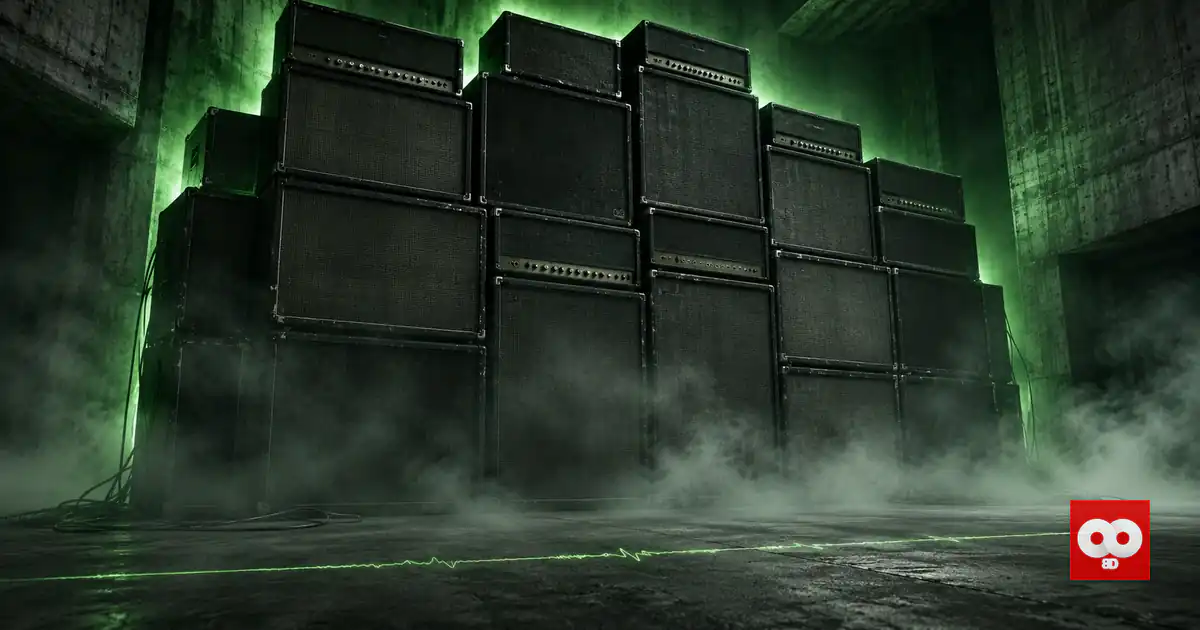
The same year, Anderson founded Southern Lord, the label that would release most of Sunn O)))’s music and, later, Earth’s own albums. The homage gradually became something independent. Sunn O))) concerts, played in hooded robes amid fog, at volumes that make the room vibrate, turned drone metal into a ritual experience. In an interview with Premier Guitar, Anderson described the vintage Sunn Model T amplifiers from the early 1970s as “the third member of the band”.
The band’s most ambitious studio work, Monoliths & Dimensions (2009), brought in brass, strings, choir and the voice of Attila Csihar, showing that the genre could absorb orchestral and spectral writing without losing its weight. Later collaborations, including Soused with Scott Walker in 2014, confirmed that drone metal had become a meeting place for experimental musicians from very different backgrounds.
Boris and the Japanese connection
In Japan, the trio Boris developed a parallel approach. Their 1996 album Absolutego was issued in some editions with the subtitle Special Low Frequency Version, an explicit acknowledgement of Earth, and the band’s very name comes from a song by the Melvins, another key influence on slow, heavy rock. Boris moved freely between drone, noise, psychedelia and pop, and their 2006 collaboration with Sunn O))), Altar, is one of the genre’s most accessible records. Their connection to the wider Japanese scene, including Japanoise, shows how drone metal overlapped with noise and free improvisation.
How drone metal works
On paper, a drone metal track looks like almost nothing: a chord, held. In practice, several mechanisms keep it alive.
Overtones and intermodulation. A heavily distorted guitar generates a dense cluster of harmonics. When two guitars or a guitar and bass sustain notes together, their overtones interfere, producing beating, difference tones and shifting resonances. The listener hears a sound that seems to change constantly even when no one is playing a new note. The site’s guide to harmonic complexity and sonic textures explains the acoustics behind this.
Feedback as a voice. Controlled feedback between guitar and amplifier creates tones that bloom, waver and shift pitch. Players shape it by moving relative to the speakers, which makes the performance partly a matter of positioning in space.
The room as part of the instrument. At high volume, low frequencies excite the resonances of the venue. The same piece sounds different in a club, a church or a concrete hall, a principle drone metal shares with the installations of La Monte Young and Phill Niblock.
Slowness as structure. With so little happening on the surface, the smallest change, a new note, a drum hit after five minutes of silence, carries enormous weight. The compositional logic resembles the principles described in the site’s article on minimalistic structures: reduction makes every remaining event significant.
Listening to drone metal
Drone metal is designed for volume, but the recordings do not require dangerous levels. The detail of the overtones is often clearer at moderate volume on good headphones, while concerts are best approached with musicians’ earplugs that lower the level evenly without dulling the sound. The guide to listening to drone music covers safe levels in more detail.
A sensible listening path starts with Earth 2, moves to Sunn O)))’s Monoliths & Dimensions, then to Boris and Sunn O)))’s Altar, and from there outward to Om, Khanate and the later, more melodic Earth albums. Followed in that order, the records show a genre that began as a single extreme gesture and grew into one of the most physically intense and conceptually open forms of contemporary drone music.