Phill Niblock (1933-2024) composed some of the densest and most physically immersive drone music ever recorded, and he did it with a method that can be described in a paragraph: record musicians holding single notes, layer the recordings so the pitches sit a hair apart, and play the result loudly. He also made films, ran a New York foundation that presented about a thousand performances, and curated a record label that kept a generation of experimental composers in print. This guide covers his background, his working method, his film cycle, Experimental Intermedia, and a short route into the recordings.
From photography to sound
Niblock was born on October 2, 1933, in Anderson, Indiana, and died on January 8, 2024, at age 90. According to Wikipedia’s biography, he earned a degree in economics from Indiana University in 1956, served briefly in the US Army, and moved to New York in 1958, where he worked as a photographer and filmmaker, mostly documenting jazz musicians and modern dancers. Resident Advisor’s obituary adds that he had no formal musical training and began composing in 1968.
The film work came first and stayed parallel. Niblock’s short The Magic Sun (1966-68) was made with Sun Ra’s Solar Arkestra; as Frieze reports, it was projected behind the band during concerts for some years. The same article explains that from 1973 onward he presented his own compositions alongside his films, a shift motivated partly by the cost of hiring dancers.
The method: single tones, slightly apart
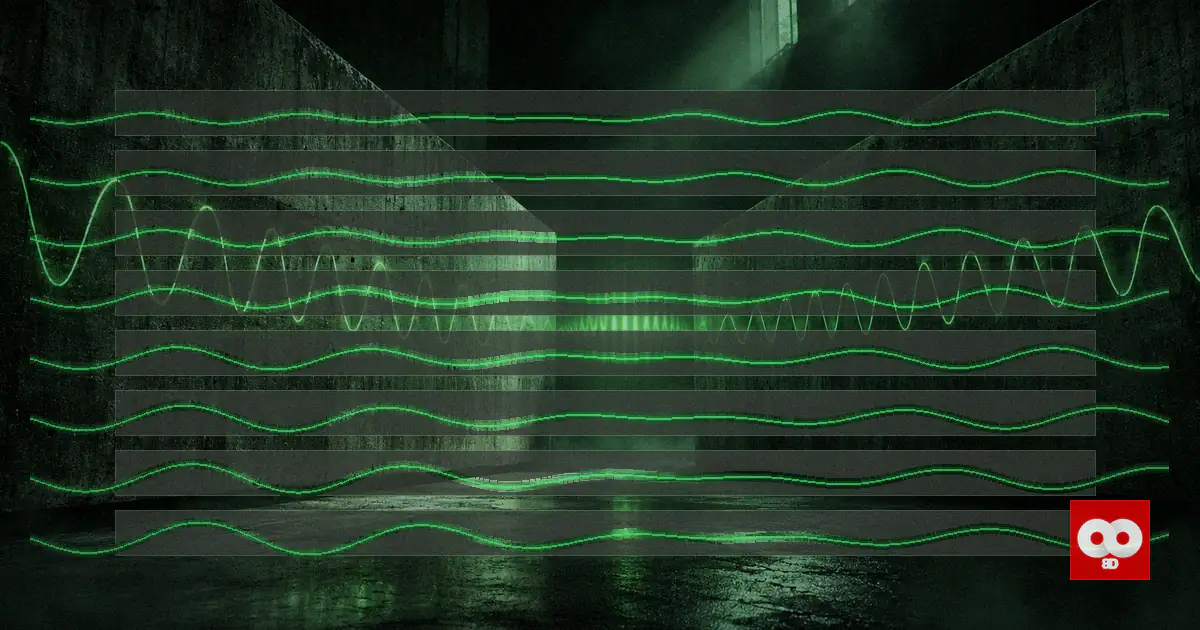
Niblock’s process is unusually well documented in the liner notes to Young Person’s Guide to Phill Niblock, the XI reissue of a 1995 Blast First and The Wire CD set. The notes describe a sequence that begins with pitch. He chooses frequencies first, and musicians tune to calibrated sine waves while watching oscilloscope patterns as they record many takes of each tone. The takes are edited into blocks of repeated notes, and the full score assigns those blocks to tracks, with the top four tracks mixed to one stereo channel and the bottom four to the other. He writes the score before dubbing and, by his own account in the notes, does not audition tone combinations beforehand.
The source material is usually acoustic: trombone, sousaphone, flute, didjeridu, tenor saxophone. The pitches are deliberately offset from equal temperament, and the notes give one example in A Trombone Piece, where twelve pitches rise by 2, 3, and 4 cycles per second across three octaves. When close pitches sound together, they generate sum and difference tones, which listeners perceive as pulses or micro-rhythms. That phenomenon, known as beating, is also the subject of work by Alvin Lucier, and it connects Niblock to the broader tradition that includes La Monte Young. For a discussion of how tuning relates to this approach, see the article on just intonation.
Technology changed during his career. According to Wikipedia, early works used tape with four to sixteen tracks, and from the late 1990s he worked in Pro Tools, sometimes with around forty tracks.
Why the volume matters
Niblock’s music was meant to be heard loud, and the reason is acoustic rather than macho. The liner notes state that louder playback brings out richer upper harmonics and recommend at least four speakers around the perimeter, calling the music architectural. Frieze quotes his own description of the effect in a room: the space shapes the sound and produces tones that are not on the original recordings, a result he called “virtually pure distortion.” The same article records a gallery visitor complaining that an installation was too quiet. A quiet playback, then, misses much of what the pieces do, and headphone listening at low level is the weakest way to meet them.
Niblock also described the origin of his interest in beating tones. CDM recounts an origin story in which a motorcycle engine beating against a diesel truck in the Carolina mountains first drew him to interference between close pitches.
The films: The Movement of People Working
His best-known film cycle, The Movement of People Working, was shot between 1973 and 1991 in rural settings in many countries, on color 16mm film, according to Wikipedia. Frieze describes the installation version as showing manual labor across twelve screens, with a computer program deciding the order in which the footage plays. The images hold on repetitive physical tasks, and the process echoes the music: small repeated motions, accumulated until pattern emerges.
The films are not illustrations of the music. They run beside it, and the pairing gives the long durations a human scale. CDM adds that Thomas Maury’s 2019 documentary Niblock’s Sound Spectrums – Within Invisible Rivers is a useful introduction for anyone who wants to see him at work.
Experimental Intermedia and XI Records
Wikipedia reports that Niblock became an artist-member of Elaine Summers’s Experimental Media in 1968, took over as director of the Experimental Intermedia Foundation in 1985, and held the post until his death. He produced its music and intermedia presentations from 1973, roughly a thousand performances in all. The foundation’s own site describes it as a nonprofit providing support for artists working in intermedia forms, and notes that it manages the compact-disc label XI Records. In 2022 it launched “Meetings with XI Composers,” online conversations and listening sessions with composers including David Behrman and Ellen Fullman.
His own music also appeared on other labels, including the British label Touch. Wikipedia lists Touch releases that include Touch Food (2003), Touch Three (2006), Touch Strings (2009), and Touch Five (2013).
Where to start listening
A few releases map the range, and each can be confirmed from the sources above.
- Young Person’s Guide to Phill Niblock (XI) gathers the early tape pieces, including Held Tones and Unmentionable Piece for Trombone and Sousaphone (both from 1981), plus Didjeridoos and Don’ts, written during Ulrich Krieger’s New York residency in the early 1990s.
- Touch Works, for Hurdy Gurdy and Voice was released by Touch in 2001. Its pieces were composed in October 1999 for Merkin Hall’s Interpretations series, and they build on Jim O’Rourke’s hurdy-gurdy and Thomas Buckner’s baritone voice, layered over many tracks.
- Four Full Flutes (1990) was made with Petr Kotik, Susan Stenger, and Eberhard Blum, according to Wikipedia.
The hurdy-gurdy, didjeridu, and flute have long histories as drone and sustained-tone instruments in folk music, which the article on drone instruments in folk music surveys. For a wider list of starting points beyond Niblock, see the guide to essential drone music albums.
Legacy
Niblock showed that a drone could be built from precision rather than from raw volume or repetition alone: each piece starts as a tuning plan and ends as a physical environment. His ideas sit alongside the long-duration work of Tony Conrad, Marian Zazeela, and La Monte Young, yet his emphasis on acoustic instruments, recorded tones, and moving image gave him a distinct place among them. The foundation’s site lists an October memorial marathon for Niblock at Roulette, and the venue had already hosted Winter Solstice: 24 Hours of Music and Film, two days of twelve hours each marking his 90th birthday. He had performed at Cafe OTO in London on May 6, 2023, in a trio with Rie Nakajima and Thurston Moore, per CDM. The foundation he directed continues, with its label and live series still active. Further context sits in the glossary entry on Phill Niblock and in the entry on durational performance.